
Federal Bureau Release Outcomes
The Federal Bureau of Prisons, or BOP, manages people serving federal sentences. No federal prison was identified in Sterling County. A Sterling County connection therefore does not tell where a federal sentence was served or where release occurred. The BOP locator is nationwide and follows federal identity records across institutions.
A person leaving BOP can enter the community, supervised release, a residential transition setting, or another agency's custody. A detainer is a request or legal basis for another custodian to take control. “Not in BOP custody” closes only the BOP question. It does not prove the person is free from all custody. If the county record says “released to federal agency,” that county event describes a handoff, not community release.
| Record result | What it establishes |
|---|---|
| Current BOP institution | The person remains in federal prison custody as shown. |
| Released with date | BOP reports federal custody ended on that date. |
| Not in BOP custody | The person is outside BOP custody; another custodian may still hold the person. |
| County transfer to federal agency | County custody ended and federal custody likely began. |
Confirm Federal Bureau Releases
Use the official BOP inmate locator. Search by the federal register number when known. A name search can use first, middle, and last name, plus race, sex, and age filters. Identity must be matched with more than a common name.
- Establish that the case was federal. A Texas state conviction belongs in TDCJ, while a local jail stay belongs with Sterling and its receiving jail.
- Search the national BOP locator by register number or full name and available demographic filters.
- Open the matched result and record the exact custody wording, location, and release date.
- If the result says released or not in BOP custody, check the federal case and any known detainer or receiving agency.
- When the public result is unclear, contact BOP through its official channels and request the record tied to the register number.
The BOP locator information page explains the national search. The public result can retain released-person wording and a release date, which makes it more useful for federal history than a current-only county roster.
The official federal locator screen shows the search fields used for a Sterling County federal release check.
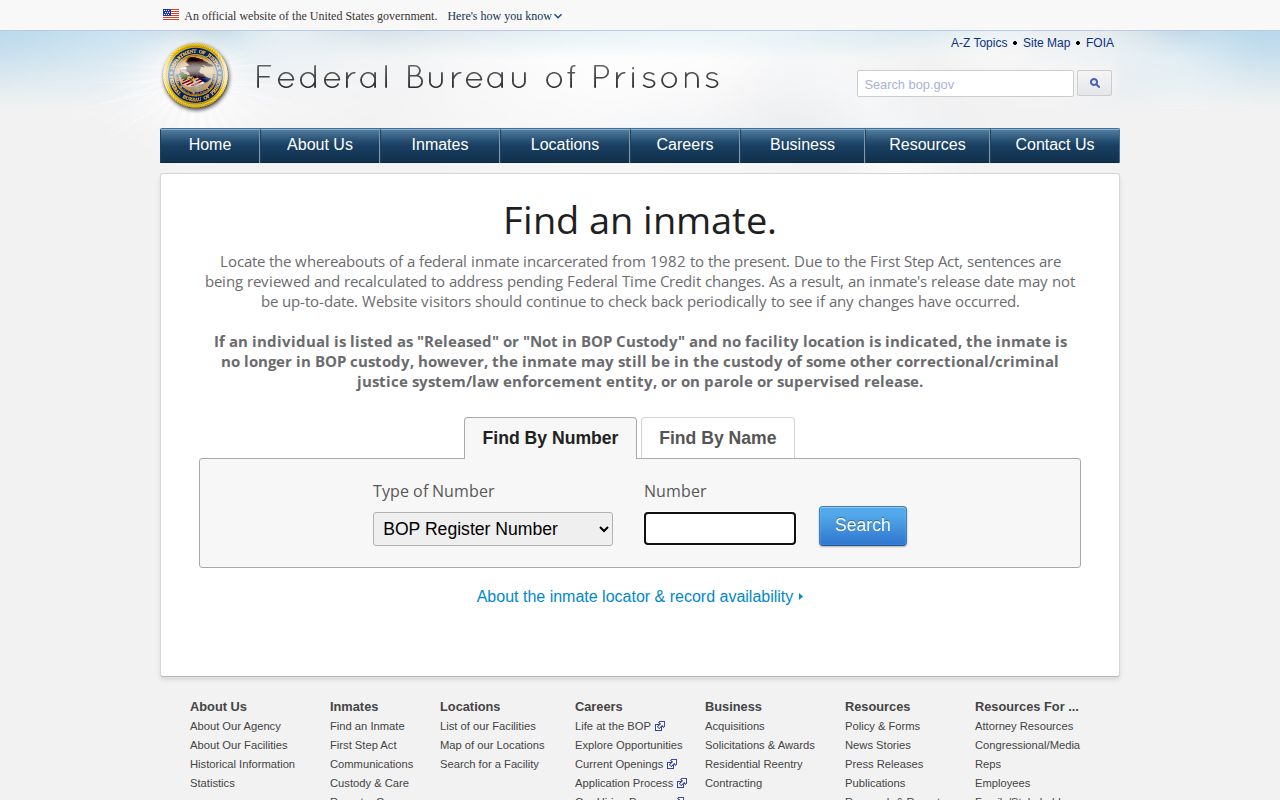
The capture confirms the correct federal search route. It should not be replaced with the Texas Department of Criminal Justice search.
Federal Bureau Release Records
BOP is a national agency within the U.S. Department of Justice. Because no BOP prison sits in Sterling County, a local street address would misroute the inquiry. Start from the matched institution or BOP locator result. Include the person's full committed name, federal register number, date of birth, institution if known, and the exact release field or record sought.
Official inmate locator and agency contact routes
BOP Inmate Locator
BOP Contact Directory
Ask narrowly for federal incarceration dates, release date, release location when public, and status language. For the legal basis, consult the federal court docket and judgment. A court sentence or release order explains authority, while BOP records answer when the agency completed its custody event.
Sterling County Federal Custody
Sterling County's sheriff and local courts do not operate the federal prison system. The U.S. Marshals Service may hold and transport federal prisoners before BOP designation. Its prisoner information page explains that separate role. A person can move from a county jail to Marshals custody and later to BOP. Each agency owns a different part of the chain.
The Sterling County released inmate search is the right starting point when the custody type is unknown. Ask Sheriff Russell Irby which agency received the person. If the answer is TDCJ, use state channels. If it is a federal agency, capture the transfer event and switch to the federal locator.
- BOP
- The federal prison agency for people serving federal sentences.
- USMS
- The U.S. Marshals Service, which handles many federal detainee movements and court-related custody tasks.
- Detainer
- A notice or legal request that another agency wants custody.
- Supervised release
- Federal court supervision after imprisonment, distinct from Texas parole.
Read Federal Release Records Carefully
A BOP release date answers when BOP custody ended. It may not state the gate time, release address, or a later agency's status. Compare the federal docket for the judgment and supervision terms. If the person entered ICE custody, the ICE locator and Enforcement and Removal Operations office own that next question.
Agency fields can update on different schedules. Save the register number, exact BOP wording, date, and access time. Then corroborate any transfer. A family report, social post, or locator no-match is only a lead. An affirmative BOP release result is stronger, and a matching receiving-agency record resolves whether custody continued.
Note: Federal release, Texas prison discharge, and Sterling County jail release are separate events held by separate custodians.
Sterling County Federal Release Chain
A complete federal check begins before BOP when the person first left local custody. Ask the Sterling County Sheriff for the actual booking facility and the final local event. The request should seek legal name, date of birth, booking number, admission date, release date and time, release reason, and receiving agency. If the record names the U.S. Marshals Service, federal custody may have continued before a BOP designation appeared.
The federal register number is the strongest public locator key. Preserve it with the committed name and birth details. Name-only searches can produce several matches or miss a person recorded under another form of the name. When BOP shows a release date, copy the exact wording. Do not turn that date into a claim about the person's current location. Supervised release is managed through the federal court and probation system, while a new custodian controls any later detention.
A federal judgment helps interpret the locator. It can identify the sentence, court, and post-prison supervision. It does not always state the moment BOP completed release processing. Conversely, a BOP date shows the agency's custody end but may not explain every court condition. Reading both records gives a more complete answer without asking either system to perform the other's function.
Older data requires the same care. Public interfaces are useful summaries, not certified files. A narrow agency request should name the register number, time span, institution, and fields needed. Ask for electronic delivery and distinguish a status answer from a copy of the release record. If an item is withheld, request the governing basis rather than filling the gap with a commercial profile.
A BOP record should never be used to verify a Reagan County jail exit or a TDCJ discharge. Those are different sovereign systems. The Sterling criminal court file, federal docket, and agency custody events form a chain only when identifiers and dates align. If they conflict, contact the office that created the disputed field.
Release timing may also differ from a projected date. A sentence calculation, halfway-house placement, court order, good-conduct credit, or detainer can affect the route, but the public locator's completed release field is the result to verify. Never present an estimate as the final event. If the date has passed and the locator still shows custody, use the institution or official BOP contact route. If the locator shows release but another agency is known to be involved, check that agency before describing a community return.
Federal records should be requested for a defined purpose such as confirming a release, reconnecting with a person, or following a court matter. Keep the answer factual. A past federal sentence does not reveal present conduct, and a locator entry should not be used to infer facts outside the record. Confirm corrections with BOP and the federal court that produced the judgment.