
Sterling County Release Date Sources
The first task is identifying the custodian. Sterling County has no confirmed operating public jail roster of its own, and a Sterling arrest may be held by another county. The Sterling County Sheriff's Office can identify the actual booking facility. If staff names Reagan County, its public roster covers current inmates only. A blank projected-date field there means the current record does not supply a date. It is not a promise that no release will occur.
A pretrial case usually turns on a magistrate, bond, dismissal, warrant, or later court order rather than a sentence-end calculation. For a county sentence, ask the actual holding sheriff to calculate time served under the judgment and ask the proper Sterling clerk for that judgment. TDCJ's field applies only after state commitment. It does not calculate a misdemeanor county-jail term.
| Custody type | Best date source | Needed confirmation |
|---|---|---|
| Pretrial county detention | Receiving jail and court order | Completed release or transfer event |
| County sentence | Holding sheriff's calculation and judgment | Time served, holds, and actual exit |
| TDCJ sentence | TDCJ projected or scheduled field | TDCJ release history after the date |
| Federal or ICE custody | The federal custodian | That agency's affirmative status |
Find a Sterling County Projected Date
Search in a fixed order. A county roster disappearance is only a clue because community release and transfer look alike online. TDCJ also states that its public web search includes only people currently incarcerated in a TDCJ facility and that its information is at least 24 hours old. A former prisoner dropping from that search is not a historical release record.
- Call the Sterling County Sheriff with the full name, exact date of birth, arrest date, and cause or booking number if known. Ask which facility owns the custody record.
- For a county detention, ask that facility for the current calculation and any hold, then ask the correct Sterling clerk for the judgment or bond order.
- For a state sentence, search TDCJ by TDCJ or SID number when possible and confirm identity with date of birth and conviction data.
- After a state release, use TDCJ's email information service or telephone route because the web search excludes former prisoners.
- After the listed day, obtain the actual release event, mode, and destination. A scheduled date alone is not final proof.
The Sterling County released inmate record path explains how to pair the jail event with the court disposition when the date has passed.
TDCJ Projected Release Date Meaning
TDCJ uses the exact label “Projected Release Date.” The agency defines the field by the date and nature of the offense. For mandatory-supervision-eligible offenses committed before September 1, 1996, a person not paroled is released on that projected date. For eligible offenses on or after that date, mandatory-supervision release is discretionary with the Texas Board of Pardons and Paroles. If BPP does not approve it, or the person is not eligible, the field may represent discharge instead.
The official TDCJ email-information page describes the field and request inputs. Its captured form and definition are shown below.
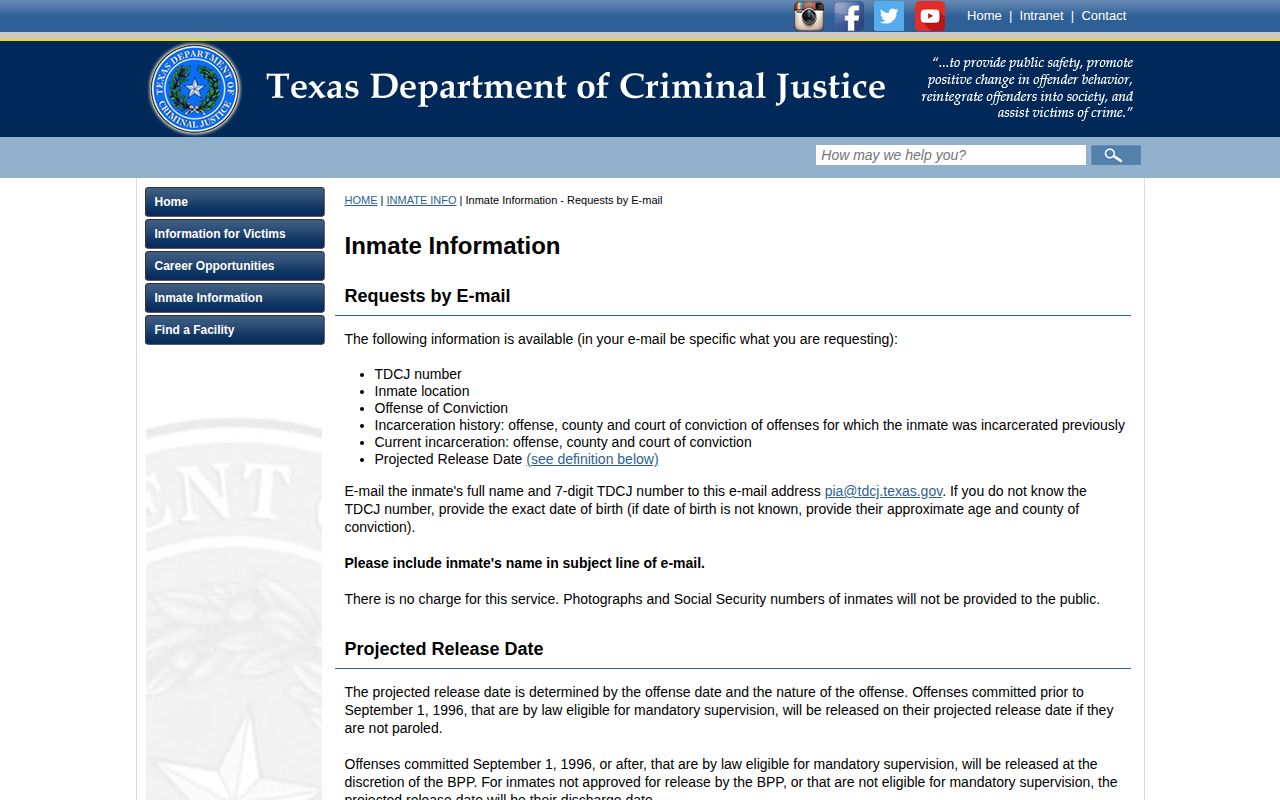
The image also documents the durable information route for a former state prisoner, whose record is no longer returned by the current-inmate web search.
Provide the full name and seven-digit TDCJ number. If that number is unknown, TDCJ accepts exact date of birth or approximate age and county of conviction. The listed information service has no charge. Ask expressly for prior incarceration history, projected date, actual release date, release mode, and whether supervision remains active.
Sterling County Good-Time Rules
Texas Government Code Chapter 498 governs good-conduct time. Section 498.003 addresses accrual by classification and participation and permits forfeiture. Section 498.004 calls good time a privilege, not a right. It affects statutory eligibility calculations as allowed by law, but it does not erase part of the court's sentence.
Parole and mandatory-supervision eligibility are governed by Government Code Chapter 508. For many prisoners, the general parole formula uses calendar time plus good-conduct time equal to one-fourth of the sentence or 15 years, whichever is less. Categories addressed in section 508.145(d) commonly require one-half of the sentence or 30 years, whichever is less, in actual calendar time without a good-time allowance, subject to offense-specific minimums and other rules. Section 508.149 lists mandatory-supervision exclusions.
Texas has no universal rule that every prisoner serves exactly 85 percent. That phrase is an unsafe federal shorthand when applied to Texas cases. Offense date, offense type, consecutive sentences, special statutes, and BPP decisions all matter. Eligibility merely opens a legal door. It does not compel release.
- Good-conduct time
- A statutory allowance used in specified eligibility calculations and subject to loss.
- Eligibility date
- The point when a case may be considered, not a guaranteed exit.
- Discharge date
- The date the sentence ends if no earlier authorized release applies.
- Mandatory supervision
- A supervised release form whose availability and approval depend on current law.
Why Sterling County Dates Change
A projected date is recalculated when the facts or governing record changes. TDCJ may receive a corrected judgment, a new sentence, or updated time allowances. Good time may be earned, forfeited, or restored. BPP may approve, deny, or withdraw a release decision. A required program or release-plan placement can delay processing. County calculations can also change after a court corrects time-served figures or another agency lodges a warrant.
| Change | Possible effect | Record to check |
|---|---|---|
| Good-time adjustment | Moves an eligibility calculation where legally allowed | TDCJ time record |
| New or corrected judgment | Changes sentence or time served | Court order and custodian calculation |
| Parole or mandatory-supervision vote | Adds approval, denial, review, or prerequisites | Current BPP vote glossary and case status |
| Detainer or warrant | Causes transfer or blocks community release | Custodian response and available hold record |
| Program requirement | Delays a scheduled state release | BPP decision and TDCJ processing status |
Note: Ask the agency to name both the field and the date it was last calculated.
Sterling County Parole Date Hierarchy
Texas parole has four distinct date stages: eligibility, panel vote, scheduled date and location, then actual release. BPP vote codes make that distinction visible. FI-1 means release when eligible, FI-2 identifies a future date, and several other approval codes require a program or transfer. RMS approves mandatory supervision. Denial codes can set later review or require service under applicable law. The live BPP vote-options glossary controls because codes may change.
TDCJ's Independent Ombudsman explains that after a favorable vote and release certificate, Classification and Records audits the case. A Scheduled Release Date and Scheduled Release Location may then appear. The scenario described can take about 14 to 21 business days, while programs and other prerequisites can extend it. The date may change without notice, even on that day.
A “release to detainer” is not community release. It closes TDCJ custody while another agency takes control. Some detainer details may be protected by Government Code section 552.134, so the public record may not name every destination fact. The responsible next custodian must confirm its own status.
Sterling County Jail Date Limits
No official Sterling or Reagan source found in the research publishes a daily release time, weekend or holiday timetable, exit door, family waiting place, or transport procedure. Do not infer that release happens at a standard hour. Sterling's small-county custody model makes that risk greater because the actual jail may be outside the county.
For a county sentence, ask the holding sheriff to read the judgment, time-served entry, applicable law, and any local time allowance policy. Ask the clerk for the signed judgment or time-served order. Bond, dismissal, a new warrant, and transfer each follow a different legal route. A bond payment channel is not a guaranteed release schedule, and a pending bond case is not the same as sentence completion.
Call before travel. Ask which facility will perform the physical event, whether all court paperwork has arrived, whether any other hold exists, and which office can later provide the booking-and-release event log.
Confirm Sterling County Actual Release
Once the projected day passes, use affirmative evidence. For county custody, obtain the receiving jail's release date and time, release authority, mode, and destination, then pair it with the Sterling court order. For state custody, request TDCJ's admission and release history and ask whether the sentence discharged or supervision continued. An IVSS notice can corroborate an event, but the contributing agency's underlying record remains stronger.
The TDCJ telephone information route is available during its posted business hours. Callers should have a TDCJ or SID number, exact date of birth, and county of conviction. Before a parole vote, TDCJ lists 844-512-0461 for review status. After a favorable vote, Review and Release Processing is 512-406-5202. General locator information uses 936-295-6371 or 800-535-0283. Verify the current numbers on the agency page before relying on them.
For notifications while a date approaches, the Sterling County VINELink and Texas IVSS explanation distinguishes county alerts from state prison and parole alerts.