
Sterling County Court Release Records
Court records form the durable bridge between arrest and custody outcome. A bond order may authorize release while the case remains pending. A dismissal or acquittal may end the court basis for detention. A judgment can impose time served, probation, a county sentence, or commitment to TDCJ. Later entries may show revocation, correction, discharge, expunction, or nondisclosure where the law permits public access.
None of those entries automatically proves the moment a jail opened the door. The judge and clerk record legal action. The Sterling County Sheriff and actual receiving jail record physical booking, transport, release, and transfer events. In this small-county system, the person may have been held outside Sterling. The strongest conclusion pairs the court order with an affirmative custodian event.
| Record | What it may establish | What still needs confirmation |
|---|---|---|
| Bond order | Release authority and case terms | Bond completion, holds, and jail exit |
| Dismissal or acquittal | Disposition of the court charge | Other cases or custodial holds |
| Judgment and sentence | Sentence, time served, probation, or commitment | Custodian's release or transfer time |
| Discharge order | End of a court-supervision term | Any separate state or federal custody |
Choose the Sterling County Clerk
Jerri McCutchen is listed in both the District Clerk and County Clerk roles. That shared leadership does not merge the jurisdictions or records. District and felony causes belong on the District Clerk path. Class A and B misdemeanor matters in the constitutional county court belong on the County Clerk path. Justice Court keeps its own lower-level docket.
- Start with the cause number. It is the safest way to identify the court and avoid a same-name match.
- For a felony or 51st District Court cause, contact the Sterling County District Clerk.
- For a county-court Class A or B misdemeanor, use the Sterling County County Clerk.
- For a lower-level Justice Court case, contact that court directly and ask whether it owns the cited cause.
- After obtaining the order, call the sheriff and named receiving jail for the actual release, transfer, or continued-custody event.
The Sterling County released inmate search path explains how to identify the actual custodian before requesting its event record.
Sterling District Release Records
The District Clerk is the records route for district-court and felony matters. Its office page lists Jerri McCutchen at Box 55, Sterling City, with phone 325-378-5191 and fax 325-378-3111. Posted office hours are Monday through Thursday, 8 a.m. to 4:15 p.m., and Friday, 8 a.m. to 2 p.m. Call before travel because schedules can change.
Jerri McCutchen
Box 55
Sterling City, TX 76951
Phone: 325-378-5191
Fax: 325-378-3111
Mon–Thu: 8 a.m.–4:15 p.m.
Fri: 8 a.m.–2 p.m.
The official District Clerk page supplies this contact information. Its captured contact block appears below.
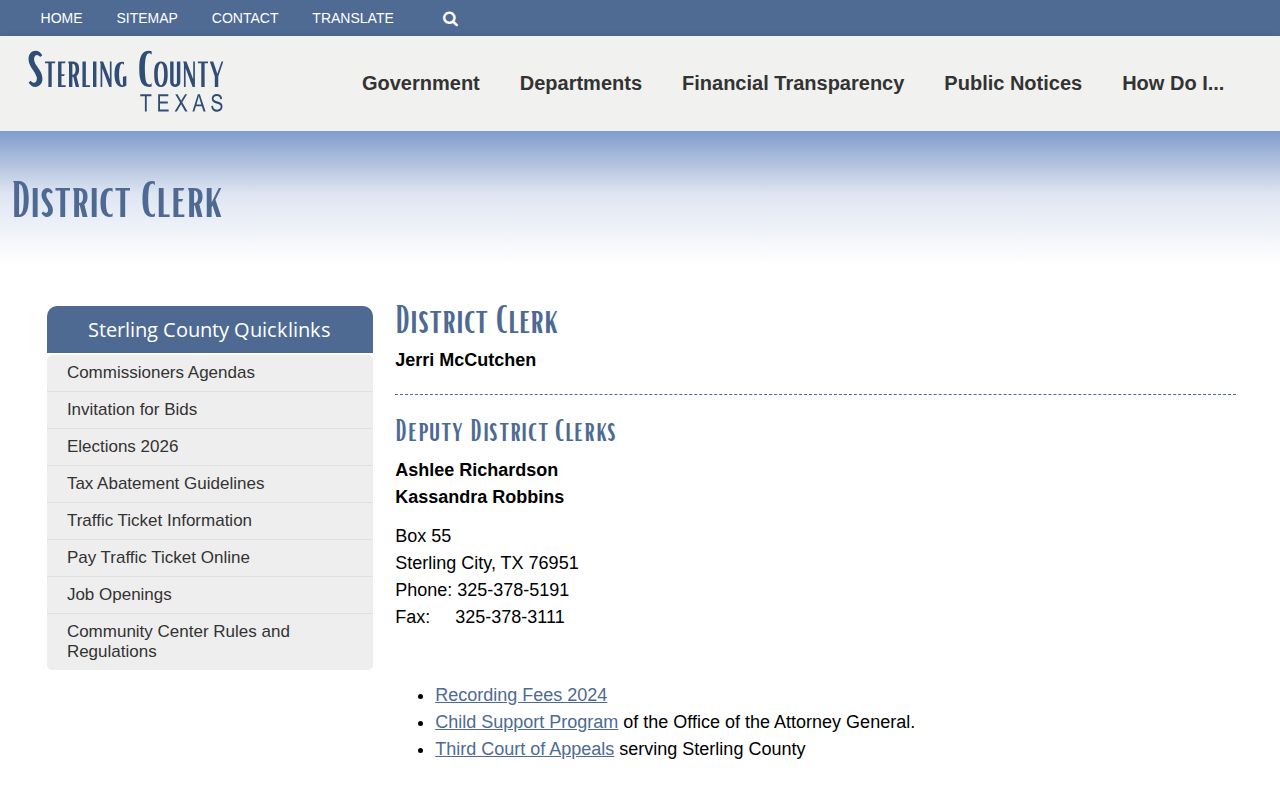
The image helps confirm the felony-record route, but the live office page remains the source for current details.
Ask for the docket sheet and specifically named documents. Useful items include the indictment or charge, bond order, judgment, sentence, time-served notation, dismissal, revocation, commitment, and later discharge order. A narrow request is easier to locate than a broad demand for every record linked to a name.
Sterling County Misdemeanor Records
The County Clerk handles county-court matters, including Class A and B misdemeanors. Its official page lists the same main address and phone but posts a Monday through Thursday closing time of 4:30 p.m., fifteen minutes later than the District Clerk page. Friday hours are 8 a.m. to 2 p.m. Preserve those office-specific schedules instead of describing one general courthouse closing time.
Jerri McCutchen
Box 55
Sterling City, TX 76951
Phone: 325-378-5191
Email: jerri.mccutchen@co.sterling.tx.us
Mon–Thu: 8 a.m.–4:30 p.m.
Fri: 8 a.m.–2 p.m.
A county-court record may explain release on bond, a time-served judgment, dismissal, a county sentence, or court-ordered probation. A bond release leaves the case pending unless the court later disposes of it. Personal bond, surety bond, cash bond, dismissal, and sentence completion are distinct legal results and should retain their exact labels.
The County Clerk page posts recording fees for other functions. Those figures must not be reused as criminal-case copy prices. Ask the clerk to quote the current charge for the docket sheet, uncertified copies, certified copies, or electronic delivery requested.
Sterling Justice Court Records
Sterling County Justice Court identifies Judge Melinda Martinez and lists Box 983, Sterling City, phone 325-378-3761. Posted hours are Monday through Thursday, 8 a.m. to 4:30 p.m., and Friday, 8 a.m. to 2 p.m. Lower-level matters may remain in this court, but the cause number and clerk response should determine ownership.
Judge Melinda Martinez
Box 983
Sterling City, TX 76951
Phone: 325-378-3761
Mon–Thu: 8 a.m.–4:30 p.m.
Fri: 8 a.m.–2 p.m.
Ask for the case style, cause number, docket sheet, bond or release order, judgment, and dismissal when those records exist and are public. Do not describe the court's payment portal as a criminal record search. Payment of a citation also does not establish a jail release event.
Note: Call first to confirm the office, case level, public access method, and current copy charge.
Request Sterling County Release Documents
Search by cause number whenever possible. If it is unknown, provide the full name, approximate filing or arrest date, and the court level believed to own the matter. Ask for existing documents rather than asking the clerk to answer a legal question or create a new report. Request the docket sheet first because it can identify the exact orders needed.
| Requested item | Release question it helps answer |
|---|---|
| Docket sheet | What actions and orders appear in sequence |
| Bond order | What authority permitted pretrial release |
| Judgment and sentence | Whether the result was time served, probation, jail, or TDCJ |
| Dismissal or acquittal | Whether the visible charge ended without conviction |
| Revocation or discharge order | Whether court supervision changed or ended |
re:SearchTX offers statewide access for participating Texas courts, but participation, documents, and user access differ. If a Sterling cause or image is unavailable, return to the proper local clerk. An online no-match is not proof that no case exists.
Sterling Court and Jail Chain
The Sterling County Sheriff's Office should be the first custody contact because it can identify the arresting agency, magistrate process, and actual receiving jail. Texas Commission on Jail Standards material records zero local jail capacity, while historic reports show Sterling inmates held elsewhere without always naming the destination. Reagan County is a strong lead, not a proven destination in every case.
Ask Sterling, “Which facility booked this person, and which facility entered the release or transfer event?” If staff identifies Reagan, its current-only roster can confirm custody while the record is visible. It cannot prove release after the record disappears. Request Reagan's booking-and-release event and Sterling's arrest-and-transport record, then compare both with the court order.
A court disposition can explain why custody should end. The jail record proves when processing ended and whether the person reached the community or transferred to TDCJ, another county, BOP, or ICE. Transfer is continued custody, not community release.
Sterling County Restricted Court Records
Public access has limits. Expunction under Texas Code of Criminal Procedure Chapter 55A and nondisclosure under Government Code Chapter 411 Subchapter E-1 have different effects. Juvenile confidentiality and sealing follow Family Code Chapter 58. Active-case concerns, protected personal information, victim information, medical facts, and court orders may also restrict a record.
Judicial records follow court-access rules and clerk law. The Texas Public Information Act does not apply to the judiciary in the same manner as an executive agency. Direct a court request to the clerk and follow that office's copy and access rules. Do not attempt to bypass a sealed, expunged, or otherwise restricted record.
- Expunction
- A statutory court process that directs covered records to be destroyed or returned as ordered.
- Nondisclosure
- An order restricting public criminal-history disclosure without being identical to expunction.
- Disposition
- The legal outcome or action recorded in the court case.
- Remand
- An order returning a person or matter to custody or another stage of proceedings.
Confirm Sterling County Physical Release
Finish with the custodian. Give the sheriff or receiving jail the person's name, date of birth, approximate booking date, cause number, and booking number if known. Ask for booking date and time, release date and time, release reason or authority, destination or receiving agency, bond entry, and relevant charge or cause references.
An affirmative jail event plus the matching court order is the strongest proof of both the physical and legal questions. A court order alone is strong evidence of legal authority but weaker for exact gate time. A roster disappearance, projected date, or no-match remains only a lead.
The records should also be read for the next custodian. A county release to TDCJ, BOP, ICE, or another county ends one agency's control while detention continues elsewhere. Accurate wording identifies that handoff instead of stating that the person returned to the community.