
Sterling County Parole Versus Probation
A Sterling County release does not by itself establish supervision. A person may leave a receiving jail on bond, complete a county sentence, enter community supervision under a court judgment, transfer to TDCJ, or later leave state prison on parole or mandatory supervision. Bond is not parole. It normally means the criminal case remains pending under court-set terms. Parole follows a prison sentence and leaves the person under state legal supervision even though the person lives outside a prison.
Probation is imposed by a sentencing court and administered through a community supervision and corrections department, or CSCD. Sterling County is served by Concho Valley CSCD. Its officers are not TDCJ state employees, though TDCJ's Community Justice Assistance Division funds and oversees parts of the local system. The source record matters because a person can serve probation without ever entering TDCJ prison custody.
| Question | Parole or mandatory supervision | Probation or community supervision |
|---|---|---|
| Who orders it? | BPP decides release under state law. | The sentencing court imposes the term. |
| Who supervises? | TDCJ Parole Division, with Sterling routed to San Angelo DPO. | Concho Valley CSCD and the sentencing court. |
| How is it checked? | TDCJ information, BPP status, and the assigned DPO. | The judgment, court clerk, and CSCD. |
| How does it end? | State discharge or sentence completion. | Court and CSCD discharge records. |
Verify Sterling County Post-Release Status
Begin with the custody system, not a name-only web result. TDCJ's public inmate search is limited to people currently incarcerated in a TDCJ facility. Once a person leaves prison, a no-match does not confirm parole, discharge, or community release. The direct TDCJ information routes are more useful for prior incarceration and current supervision. For probation, the TDCJ inmate search is the wrong system from the start.
- Match the person with a TDCJ or SID number, exact date of birth, and county of conviction where possible.
- Ask TDCJ whether the release was to parole or mandatory supervision, the release date, and whether the term is active or discharged.
- Use the TDCJ county cross-reference to confirm that Sterling routes to San Angelo DPO.
- For court probation, obtain the judgment and discharge entries from the proper Sterling clerk, then confirm the assigned department with Concho Valley CSCD.
- Record the agency's exact status wording. Do not turn a favorable vote, projected date, or roster disappearance into an actual release claim.
The Sterling County released inmate search and record path can identify the receiving jail and court record before supervision is checked. This order prevents a short county detention from being mistaken for a TDCJ sentence.
Sterling County State Parole Office
TDCJ's official directories expressly assign Sterling County to the San Angelo District Parole Office in Region V. That is the concrete routing point for a person released from TDCJ to parole or mandatory supervision in this area. The office can give official routing instructions, but it is not a public county-jail release archive and should not be asked to reconstruct a Reagan County booking.
1070 Gateway Drive
San Angelo, TX 76905
Phone: 325-947-8644
Fax: 325-947-8599
The Region V office directory publishes this contact block. The directory should be checked before travel because assignments and office information can change.
The official county-to-DPO page shows Sterling's routing. Its captured listing appears below and helps distinguish the correct state office from a local probation department.
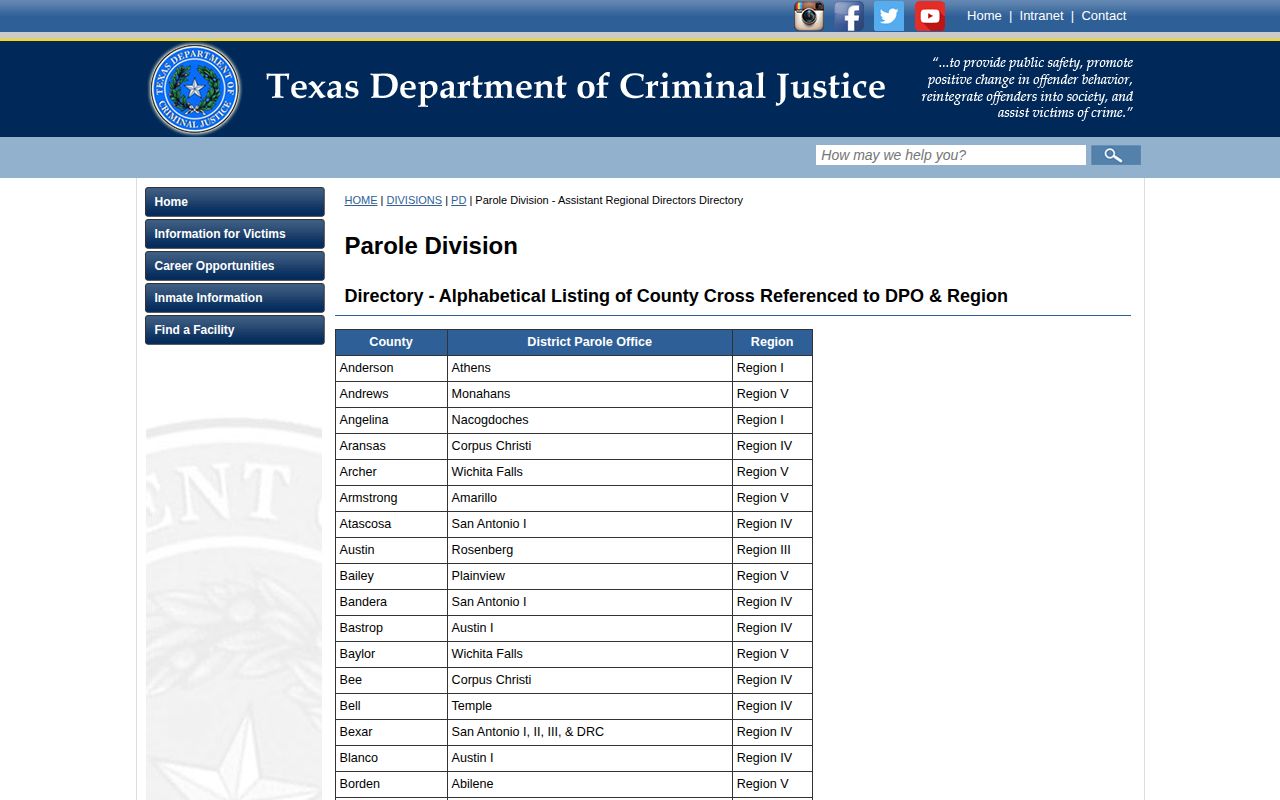
The image documents the county assignment, while the live directory remains the controlling source.
Note: Do not publish a person's reporting time, residence, travel plan, or other sensitive supervision condition.
Sterling County Probation Office Route
Concho Valley Community Supervision and Corrections Department serves seven counties, including Sterling. It handles court community supervision, not state parole. A person may enter this local system after a county sentence or under a judgment that does not involve TDCJ incarceration. Completed probation is therefore confirmed through CSCD and court discharge information, not through an absent TDCJ inmate result.
3036 N. Bryant Boulevard
San Angelo, TX 76903
Phone: 325-659-6544
The Concho Valley CSCD service-area page identifies Sterling County and the main office. The sentencing court still owns the judgment and later order. District or felony causes go to the District Clerk, while county-court misdemeanor matters go to the County Clerk. Shared clerk leadership does not merge those jurisdictions.
Ask for the cause number, judgment, community-supervision terms, revocation entries, and discharge order that are public in that case. A clerk record can explain whether a term was imposed or ended. It may not show the physical time when a jail completed release processing.
Sterling County Parole Date Stages
Eligibility, a panel decision, a scheduled release, and the actual prison exit are separate events. The Texas Board of Pardons and Paroles may issue an approval code, yet release-plan review, a required program, a detainer, or another prerequisite can remain. TDCJ's Independent Ombudsman explains that after a favorable vote and release certificate, Classification and Records audits the case and may post a Scheduled Release Date and Scheduled Release Location.
That process can take roughly 14 to 21 business days in the scenario described by the agency, and the scheduled date can change without notice. A release to a detainer closes one custody segment but does not mean the person reached the community. The receiving agency then controls the next status. Some specific detainer information may be restricted under Texas Government Code section 552.134.
| Stage | What it establishes | What it does not establish |
|---|---|---|
| Eligibility date | The case may be considered under law. | Approval or release. |
| BPP vote | The panel's decision and stated prerequisites. | Completed gate release. |
| Scheduled date | TDCJ's current processing plan. | A date that cannot change. |
| Release record | The recorded exit, mode, and status. | Community arrival if transferred to another custodian. |
The Sterling County projected release date page explains these date calculations and the effect of good-conduct time in more depth.
Sterling County Parole Decision Codes
BPP codes give detail, but they must be read from the current glossary. FI-1 means release when eligible. FI-2 identifies a future date. FI-3R, FI-4R, FI-5, FI-6, and related votes can require a program or transfer. RMS approves mandatory supervision. NR denies parole and sets later review, while other denial codes carry different effects. BPP may withdraw an approval if new information arrives.
The BPP vote-options page is the authoritative live glossary. A code helps explain the review result. It does not replace the later TDCJ release event.
- Parole
- Conditional release from prison while the state sentence and supervision continue.
- Mandatory supervision
- A statutory release form subject to eligibility and, for many cases, BPP review.
- Probation
- Court-ordered community supervision administered through a local CSCD.
- Discharge
- The official end of the applicable sentence or supervision term.
- Detainer
- A hold or request that can move a person to another custodian instead of the community.
Sterling County Warrants and Absconders
An absconder is a supervised person who stopped reporting and whose whereabouts are unknown. That label does not mean supervision ended. A warrant or revocation process may lead to renewed custody. TDCJ lists a 24-hour absconder tip line at 866-680-6667, and callers may remain anonymous. The public web search described by TDCJ is limited to certain absconding sex offenders, so it is not a complete list of all parole absconders.
Texas IVSS also has two distinct layers. TDCJ IVSS covers state prison and parole notifications, including some supervision warrant actions. IVSS-Counties covers participating county custody and supervision feeds. Neither is a durable discharge archive. A notification should be tied back to the contributing agency's underlying record before drawing a release conclusion.
Conditions vary by order and person. At a high level, they may govern reporting, travel, programs, or conduct. Public summaries should never guess at a private condition. Official instructions come from the supervising office and the signed order.
How Sterling County Supervision Ends
Successful completion requires an affirmative discharge record. For parole or mandatory supervision, ask TDCJ whether the term remains active and request the release or discharge history through its direct information channels. For probation, ask Concho Valley CSCD and the sentencing court for the final discharge entry. A no-match, an old projected date, or silence in a live roster cannot substitute for that record.
Texas Government Code Chapter 508 governs parole and mandatory supervision. Court records and supervision files can contain protected material, so public access may be limited. Request only the existing record needed to confirm status. If an agency withholds information, its cited authority and the public portion of the record should guide the next step.
Note: “Off supervision” should be used only after the responsible state agency or court record confirms discharge.