
San Angelo Parole Releases
The San Angelo District Parole Office supervises people assigned through TDCJ Parole Division. Its official county cross-reference places Sterling County in this office's service area. A person on parole or mandatory supervision has left prison but remains under legal supervision. That status is not the same as sentence discharge.
A Sterling County arrest does not automatically create a San Angelo parole record. Many local arrests involve pretrial detention, bond, a county sentence, or probation. Those remain with the Sterling Sheriff, actual receiving jail, local court, and Concho Valley CSCD. The DPO becomes relevant after TDCJ releases a state prisoner to supervision and assigns the case to this district.
| Release path | Responsible record owner | San Angelo DPO role |
|---|---|---|
| County bond or time served | Receiving jail and Sterling court | None unless a separate state parole case exists |
| Court probation | Concho Valley CSCD and sentencing court | Not the supervising agency |
| TDCJ parole | TDCJ and BPP | Local state-supervision routing |
| Mandatory supervision | TDCJ and BPP | Local state-supervision routing |
| Sentence discharge | TDCJ discharge record | No active term after confirmed discharge |
Confirm a San Angelo Release
Start with TDCJ because it owns the prison release event. The public inmate search lists only people currently incarcerated in a TDCJ facility. Once the person leaves, use TDCJ's direct email, telephone, or open-records route. A no-match cannot show whether the person was paroled, discharged, transferred, or simply mismatched.
- Identify the person with a TDCJ or SID number, exact date of birth, and county of conviction.
- Ask TDCJ for actual release date, release mode, and whether the state supervision term is active or discharged.
- Check the TDCJ county cross-reference for Sterling's current DPO assignment.
- Use the Region V directory to verify the San Angelo office contact.
- Ask only for appropriate routing or public status. Do not request a private reporting plan or sensitive condition.
The Sterling County released inmate search provides the custodian-first path when it is unclear whether the case reached state prison.
San Angelo Office Contact
The official TDCJ Region V directory lists the office at 1070 Gateway Drive in San Angelo. It gives a phone and fax route but does not turn the office into a public walk-in release archive. Call before travel and verify what public service the office can provide for the question.
1070 Gateway Drive
San Angelo, TX 76905
Phone: 325-947-8644
Fax: 325-947-8599
The official Region V page supplies the contact block. Its captured listing appears below.
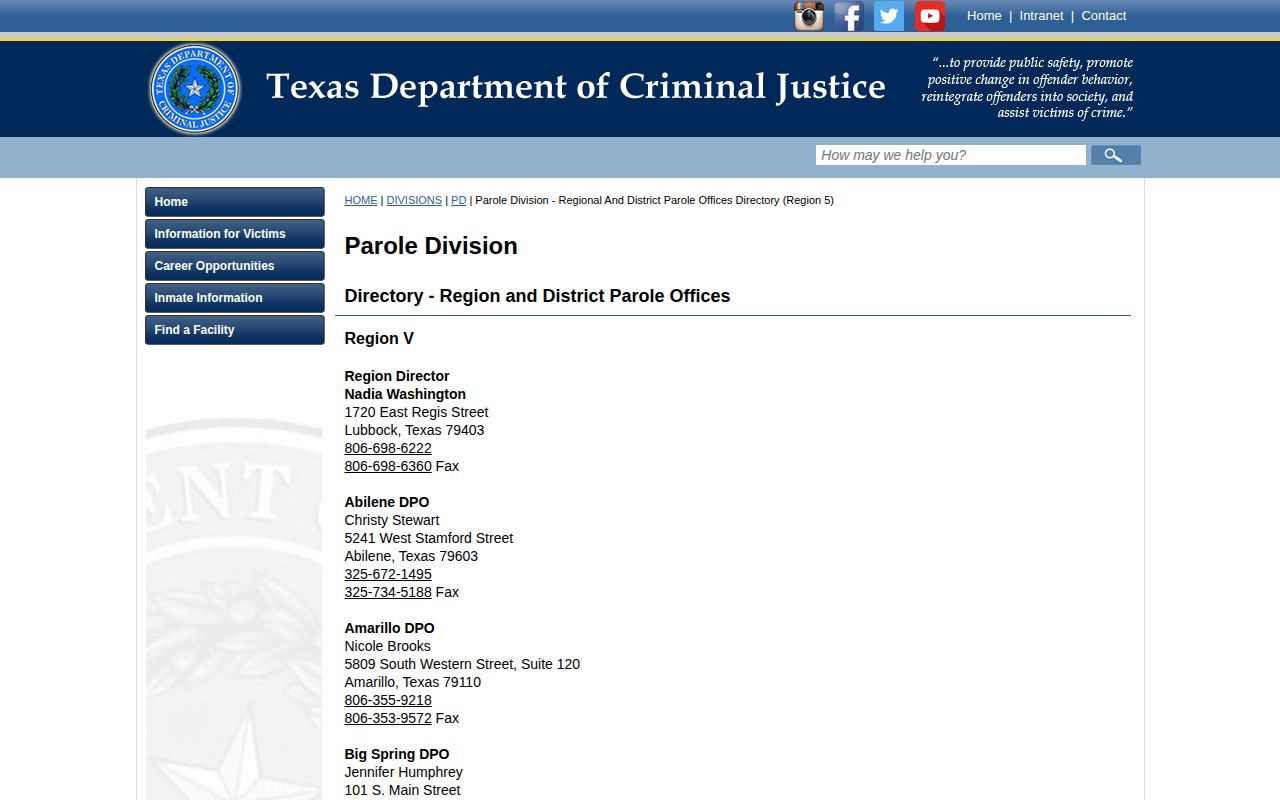
The screenshot documents the published office details, while the live directory should be checked for later changes.
Note: The DPO can confirm office routing, but central TDCJ records remain the durable source for an admission-and-release history.
Sterling County DPO Assignment
The county-to-office mapping is distinctive because Sterling County has no TDCJ unit. State prisoners may serve time at units elsewhere, yet a release to local parole supervision can still route to San Angelo. The geographic office assignment concerns community supervision after a state release, not the location of the prison gate.
TDCJ's official county directory shows Sterling in the San Angelo DPO assignment. The manifest capture below preserves that source context.
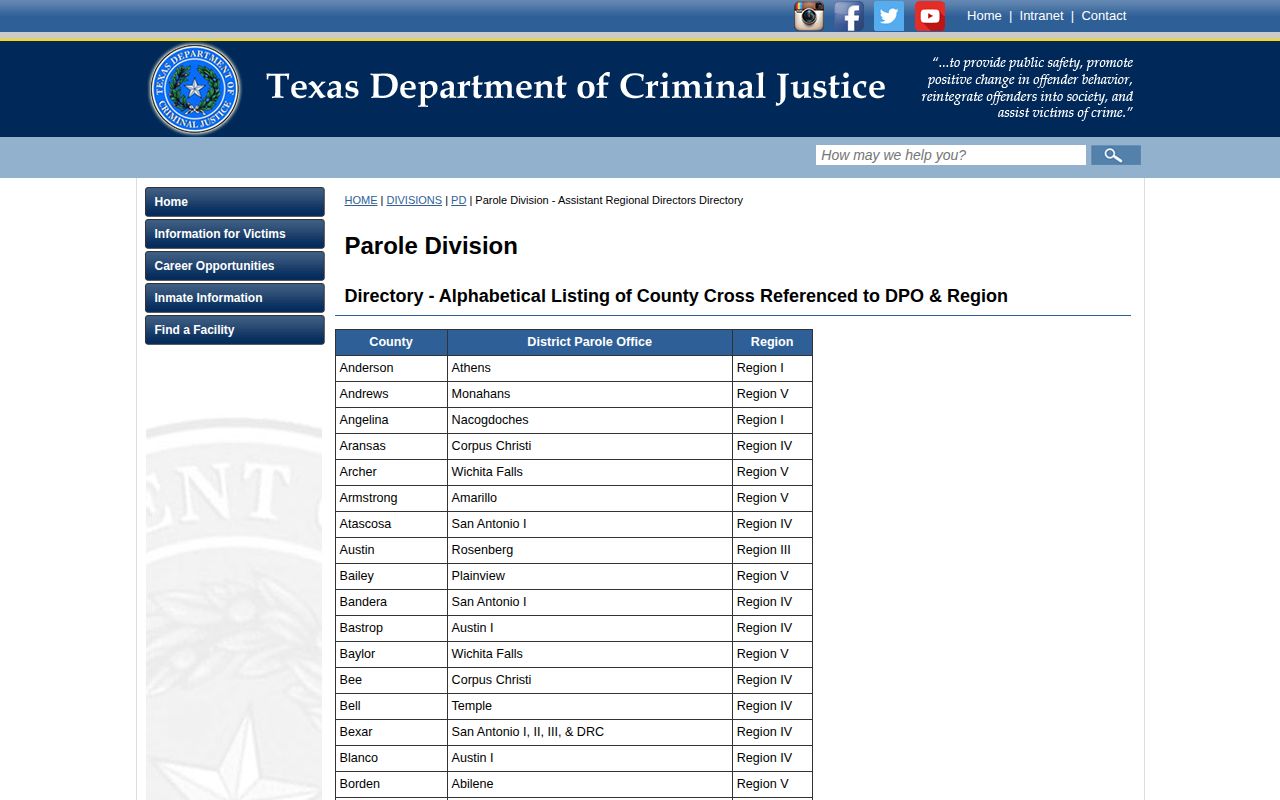
The assignment gives a concrete contact route. It should still be verified in the live directory because caseload boundaries and office information can change.
A person may also be supervised in another area after an approved transfer. Do not infer a residence or reporting place from county of conviction alone. Use the assigned agency's current answer.
San Angelo Parole Date Stages
Parole eligibility is not approval. Approval is not scheduled release. A scheduled release is not the actual gate event. BPP reviews the file and records a vote; TDCJ then completes release processing, checks prerequisites, and records the physical event. This sequence matters when someone appears likely to leave prison but has not yet arrived in the community.
| Stage | Official source | Meaning |
|---|---|---|
| Eligibility | TDCJ calculation and Texas law | The case can be considered |
| Panel vote | BPP status and vote code | Approval, denial, review, or prerequisites |
| Scheduled date/location | TDCJ release processing | A current plan that can change |
| Actual release | TDCJ release record | The recorded exit and mode |
| DPO assignment | TDCJ Parole Division | The office responsible after supervised release |
The Independent Ombudsman describes a scenario in which processing after a favorable vote and release certificate can take roughly 14 to 21 business days. Required programs or other conditions can extend the wait. TDCJ also warns that a scheduled day can change without notice.
San Angelo Parole Vote Records
The Texas Board of Pardons and Paroles uses vote codes. FI-1 means release when eligible, while FI-2 names a future date. FI-3R, FI-4R, FI-5, FI-6, and related results can require a program or transfer. RMS approves mandatory supervision. NR denies and sets later review. Other denial codes have different effects.
The live BPP vote-options glossary should be used because codes evolve. BPP may withdraw an approval after receiving new information. No vote code alone proves release.
- Parole
- Conditional state-prison release with continued supervision.
- Mandatory supervision
- A statutory supervised release form subject to eligibility and applicable BPP review.
- Release certificate
- A state document used in the release-processing sequence.
- Discharge
- The official end of the applicable sentence or supervision.
- Detainer
- A hold that can route a person to another custodian instead of the community.
San Angelo Warrants and Absconders
An absconder is a supervised person who stopped reporting and whose location is unknown. It is not a successful discharge. TDCJ publishes a 24-hour tip line at 866-680-6667 and says a caller may remain anonymous. Its described public online search is limited to certain absconding sex offenders, so it is not a full list of all parole absconders.
A supervision warrant can lead to arrest and a revocation process. TDCJ IVSS may send some notices about state supervision warrant actions, but an alert is not the complete underlying file. Confirm status through TDCJ and follow the responsible agency's directions. Do not publish guessed conditions or sensitive case facts.
Texas IVSS-Counties is a different service for participating county custody and supervision feeds. The separate TDCJ IVSS covers state prison and parole notifications. Neither service is a historical discharge archive.
San Angelo Versus Local Probation
Concho Valley CSCD, at 3036 N. Bryant Boulevard in San Angelo, serves Sterling County court probation. That department and the sentencing court handle community supervision imposed by a local judgment. Its staff are not TDCJ state employees, even though a TDCJ division oversees and funds parts of the statewide CSCD framework.
The distinction changes the lookup. A probation discharge comes from CSCD and the court record. A parole discharge comes from TDCJ. Someone can complete a short county stay and enter probation without appearing in TDCJ prison records at all. Conversely, a person leaving TDCJ may be on state parole without a local probation case.
The Sterling County parole and probation comparison gives both contact paths and explains which court record to request.
San Angelo Supervision Discharge
Confirm the end of supervision with an affirmative record. Ask TDCJ whether parole or mandatory supervision is active or discharged and request release history through the agency's direct information channels. The DPO can provide routing instructions, while central records can answer the durable historical question.
A no-result from the current TDCJ inmate search does not mean discharge because that search excludes people no longer incarcerated. A roster disappearance is even less useful for state supervision. Court disposition alone may explain a sentence, but TDCJ owns the state release and discharge status.
If the release was to a detainer, TDCJ custody may close while another agency takes control. That is not community release. Some detainer detail may be restricted under Government Code section 552.134, so use the originating event plus the receiving custodian's current status.